


Believe it or not, The Oak Tree series was based on a true story.
Well… sort of.
I had a friend who moved away. Not long after, she was killed in a car wreck.
There wasn’t some dramatic fallout. No life-altering spiral. Just the quiet weight of something unfinished. The kind of loss that doesn’t explode. It just sits there.
Years later, I was driving through Savannah, Georgia, when a thought hit me out of nowhere.
What if she had gotten a phone call?
Not a meaningful one. Not some dramatic warning. Just something that delayed her leaving the house by five minutes.
Five minutes that would’ve put her at a different intersection.
Five minutes that might have changed everything.
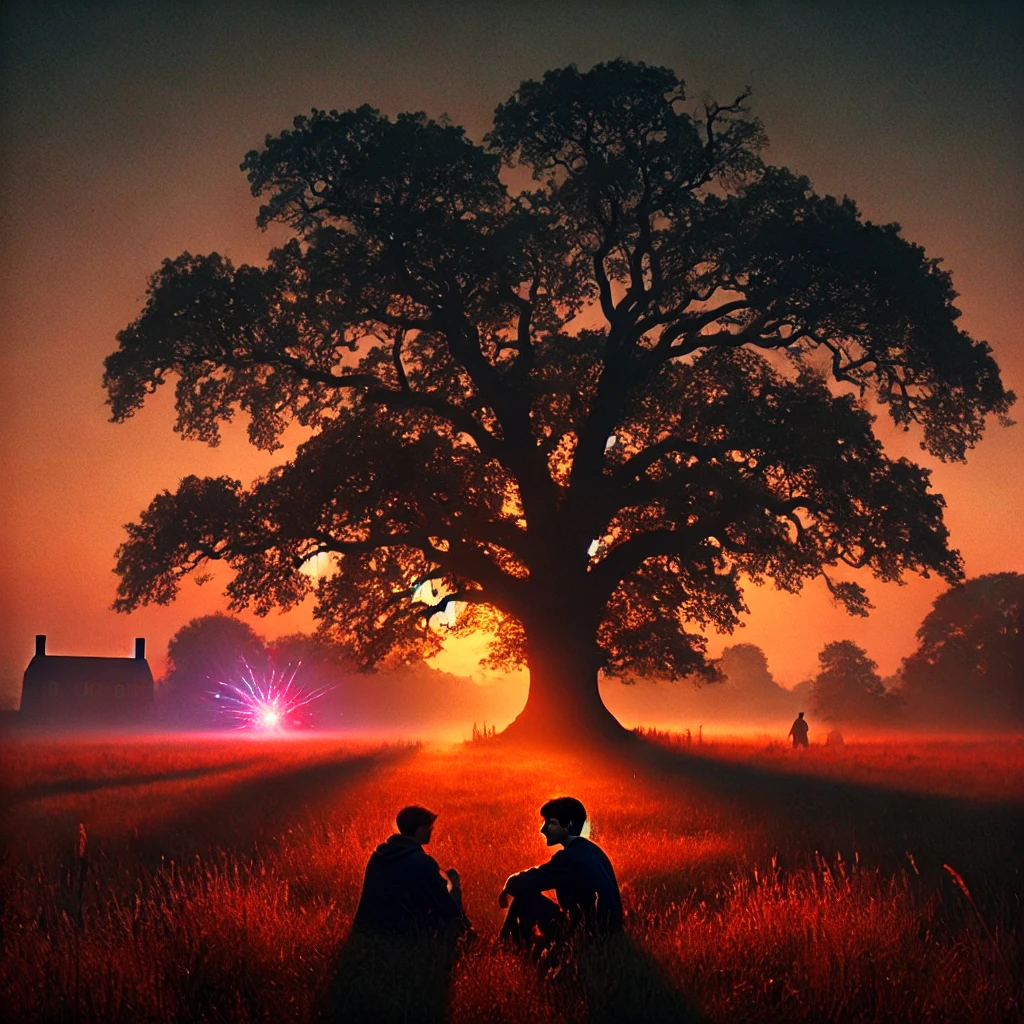
That idea stayed with me. Along with all of those beautiful Savannah oaks, hence the name, Under the Oak Tree.
The Phone Call That Wouldn’t Leave Me Alone
At first, the idea felt small. Almost selfish.
The kind of “what if” everyone has but quickly dismisses because there’s no point in going down that road. You can’t change the past. You shouldn’t torture yourself with hypotheticals.
But the more I sat with it, the more it bothered me.
Not because I wanted to save someone.
But because of what that impulse revealed.
If time travel were possible—even in the smallest way—would we use it to fix something personal? Or would it spiral into something much bigger?
That’s where the story started to split.
Why I Didn’t Want a Typical Time Travel Story
Most time travel stories follow the same arc:
- Someone goes back.
- They change something.
- Everything breaks.
- They’re forced to undo it.
That’s not a criticism. It’s a good story. It works for a reason.
But it wasn’t the story I wanted to tell.
Because if time travel were real, it wouldn’t just be about regret.
It would be about power.
And power doesn’t stay small for long.
Being able to save one person wouldn’t be the end of the story—it would be the beginning of something much more complicated.
So instead of asking, “What happens when people mess with the past?”
I wanted to ask something else:
What happens if someone actually wins at time travel?
What if they don’t immediately break everything?
What if the consequences are quieter… slower… harder to see?
The Real Reason the Story Felt Personal
Here’s where I’ll be completely honest.
A lot of The Oak Tree series exists because I was lazy.
Writing about places you’ve actually been and moments you’ve actually lived makes things much easier. You don’t have to imagine the texture of a room or the way a crowd feels. You already know it.
But that laziness did something unexpected.
It grounded the story.
Scenes that never happened in the way they appear in the books were still rooted in real places and real timelines.
The chapter about seeing Remy Zero at the Crawfish Boil in Birmingham?
That happened.
There was no Eric. No Kaitlyn. No time travel.
But there were people standing in that crowd who would recognize the moment immediately. And that mattered to me.
Because once a story is anchored to reality—even loosely—it starts to feel possible.
And possibility is where meaning lives.
Assigning Meaning to What Didn’t Happen
The Oak Tree itself didn’t exist the way it does in the books.
But the feeling did.
The sense that certain places carry weight because of what might have happened there. The idea that time isn’t just something that passes—it’s something we interpret.
I wasn’t trying to write a scientific explanation for time travel.
I was trying to explore why humans can’t stop imagining ways to undo loss.
Why five minutes feels like it could change everything.
And why we keep assigning meaning to moments that are already gone.
Why I’m Glad I Wrote It
I don’t write fiction the way I write essays.
Fiction lets questions linger.
It lets contradictions exist without resolution.
It allows things to feel true without needing to be proven.
Before I wrote essays about meaning and misunderstanding, I explored those ideas through story.
The Oak Tree series wasn’t about fixing the past.
It was about living with the knowledge that we’d want to—if we could.
And maybe about learning what to do with that impulse instead.
Final Note
I don’t think you need time travel to understand regret.
But sometimes writing about impossible things is the only way to tell the truth about very human ones.
Want to read The Oak Tree series?
If you’re curious about the story that inspired all of this—time travel, small-town moments, and the question of what
one phone call could change—you can find The Oak Tree books on Amazon.
Read the Oak Tree series on Amazon →
As an Amazon Associate, I may earn from qualifying purchases.